Nos ingénieurs sont là pour vous aider.

|
$$ \text{EFL} = \frac{n \, D}{4 \left( n - 1 \right)} $$
|
|
$$ \text{BFL} = \text{EFL} - \frac{D}{2} $$
|
|
$$ \text{NA} = \frac{2 d \left( n - 1 \right) }{n \, D} $$
|
| EFL | Effective Focal Length |
| BFL | Back Focal Length |
| NA | Numerical Aperture |
| n | Refractive Index |
| D | Diameter of the ball lens |
| d | Diameter of the input source |
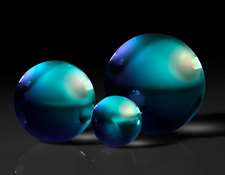
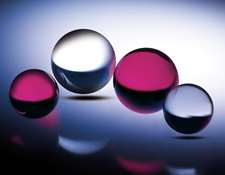
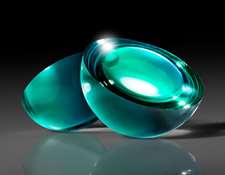
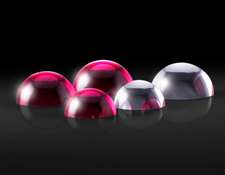
Determine the effective focal length, the back focal length, and the effective numerical aperture of a ball lens based on its diameter, its refractive index, and the diameter of the collimated beam entering or exiting the ball lens. The effective numerical aperture of the application can only be calculated if the user knows the beam diameter. Knowing the numerical aperture is particularly useful when using ball lenses to couple light from a fiber to a laser or to another fiber.





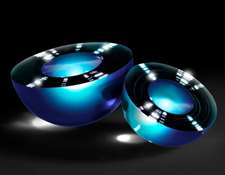
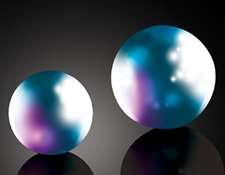
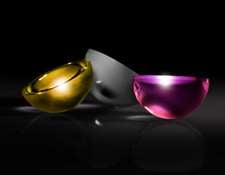
 Lentilles Billes en N-BK7
ou consulter les numéros d’autres pays
facile à utiliser
entrer les numéros de stock pour commencer
Copyright 2023 | Edmund Optics, Ltd Unit 1, Opus Avenue, Nether Poppleton, York, YO26 6BL, UK
POLITIQUE DE CONFIDENTIALITÉ | POLITIQUE DE COOKIES | CONDITIONS GÉNÈRALES | CONDITIONS GÉNÈRALES B2C | MENTIONS LÉGALES | ACCESSIBILITÉ
L'entreprise Edmund Optics GmbH en Allemagne agit comme un mandataire d'Edmund Optics BV aux Pays-Bas.
Le titulaire du contrat est Edmund Optics BV aux Pays-Bas.
Ce contenu peut comporter des éléments générés ou modifiés à l'aide de l'intelligence artificielle (IA).
The FUTURE Depends On Optics®